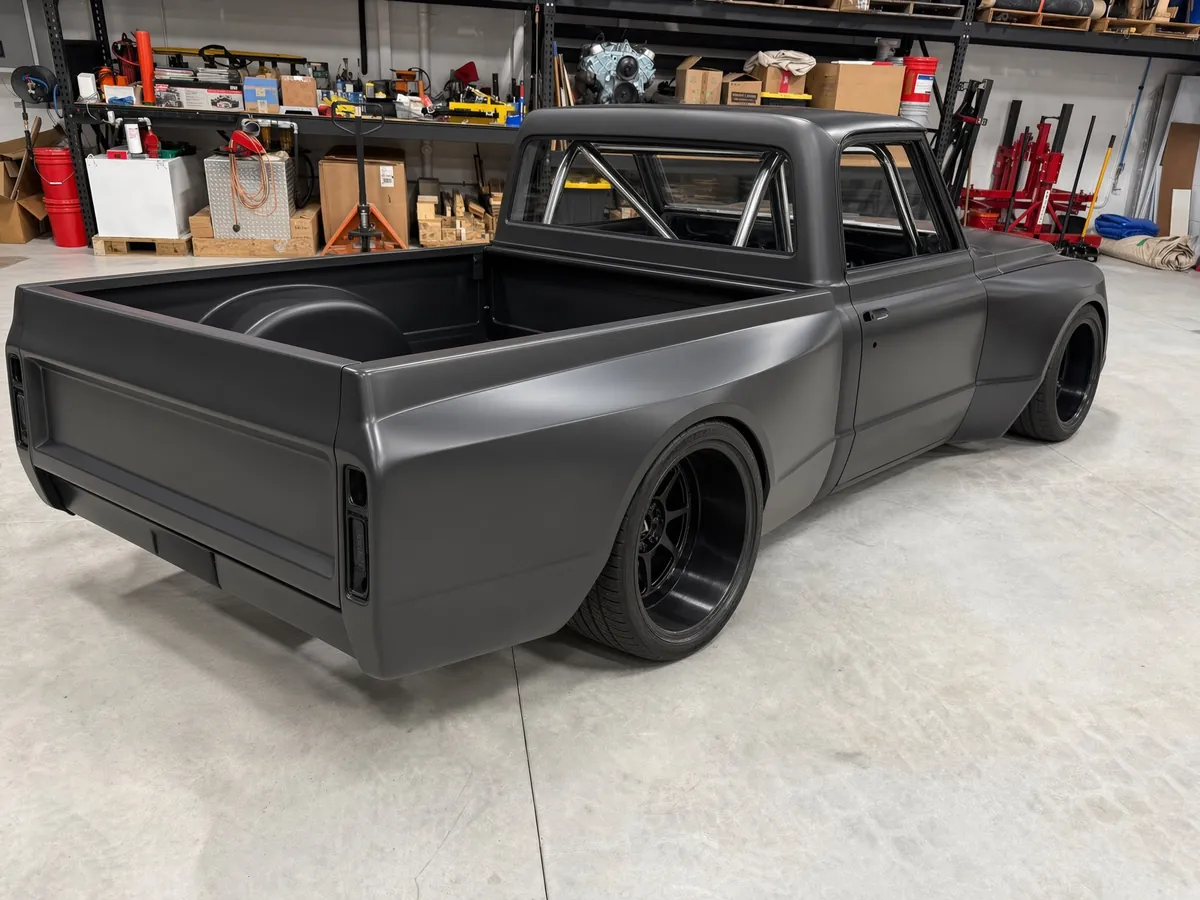
Bolt-on flares are faster, cheaper and easier. Here is what hand-forming the tubs bought us, and what it cost.
There are good bolt-on widebody kits. This truck does not use one, and the decision cost weeks.
The problem with most bolt-on flares is not quality. It is that a flare is an addition — it sits on top of the existing body and announces itself as a separate object. On a car with complicated surfacing you can get away with it. On a C10, where the bed side is essentially one long flat plane, a bolted-on flare reads as exactly what it is: a part stuck to a truck.
What hand-forming changed
Forming the tub into the bed side means the widened section shares the bed's own character line. The shoulder runs uninterrupted from the cab to the tail. There is no seam announcing where the stock truck ended and the width began, so the eye reads the whole flank as one panel that happens to be wider than a factory C10.
That is the entire difference, and it is the only reason to do it the hard way. If the tub line does not follow the bed line, hand-forming buys you nothing over a good kit and costs you a month.
What it cost
The metalwork itself was not the slow part. Getting the tub line right was. It got mocked up, looked at from twenty feet, and changed. Then again. The version on the truck now is the third attempt, and the first two were not wrong in any way you could measure — they just did not sit right when you stood back.
If you are doing this on your own truck: do the mock-up in cheap material and look at it in daylight from a distance before you commit to anything expensive. The mistakes that matter here are not visible from three feet away.